History Hub

HistoryHub

Connecting past and present

In episode 2 of AFTERLIVES, Associate Professor Fionnuala Walsh (UCD School of History) is joined by Dr Leeann Lane (DCU) and Professor Lindsey Earner-Byrne (TCD) to discuss the ordinary lived experience of Irish women in the aftermath of war and revolution and also their work uncovering poverty, welfare and the search for recognition of women’s contributions and losses.

AFTERLIVES: 'My life wasn't much after': women's voices in the Military Archives

LSBU_+_UCD

Supported by UKRI External Participatory and Collaborative Research Fund, London South Bank University and University College Dublin Decade of Centenaries Seed Funding.

In episode 2 of AFTERLIVES, Associate Professor Fionnuala Walsh (UCD School of History) is joined by Dr Leeann Lane (DCU) and Professor Lindsey Earner-Byrne (TCD) to discuss the ordinary lived experience of Irish women in the aftermath of war and revolution and also their work uncovering poverty, welfare and the search for recognition of women’s contributions and losses.

Listen on Apple | Spotify | Soundcloud

Afterlives

The aim of the Afterlives project is to uncover the life stories and contributions of rebellious women in the wake of revolution and civil war in Ireland, Finland and Germany 1918-1980s. Listen to episode 1 – Grannies, Guns, and Archives – Tracing revolutionary & post revolutionary women’s liveshere.

Listen on Apple | Spotify | Soundcloud

Useful resources

Throughout the podcast there are lots of useful resources mentioned which you can use as part of your own historical research.

These include:

Bureau of Military History

The Bureau of Military History Collection, 1913-1921 (BMH) is a collection of 1,773 witness statements; 334 sets of contemporary documents; 42 sets of photographs and 13 voice recordings that were collected by the State between 1947 and 1957, in order to gather primary source material for the revolutionary period in Ireland from 1913 to 1921. The Bureau’s official brief was ‘to assemble and co-ordinate material to form the basis for the compilation of the history of the movement for Independence from the formation of the Irish Volunteers on 25th November 1913, to the 11th July 1921’ (report of the Director, 1957).

Military Service Pensions Collection

The collection comprises a large and varied corpus of archival material and records. The two broad streams of legislation are used to illustrate the nature and content of the personal files of applicants and the relevance of the supporting administrative records and other material in the collection. The supporting administrative and other records were gathered to assist the Department of Defence and the bodies set up under the legislation in deciding on the merit of each applicant’s case.

Military Archives

From as early as 1924, the National Army, recognising the importance of the War of Independence, undertook to preserve historical documents from that time. Some of the earliest collections preserved by the Historical Section include the Collins Papers, Civil War Operations and Intelligence files and Captured Documents (Civil War up to 1925), which continue to be made available today.

Further Reading

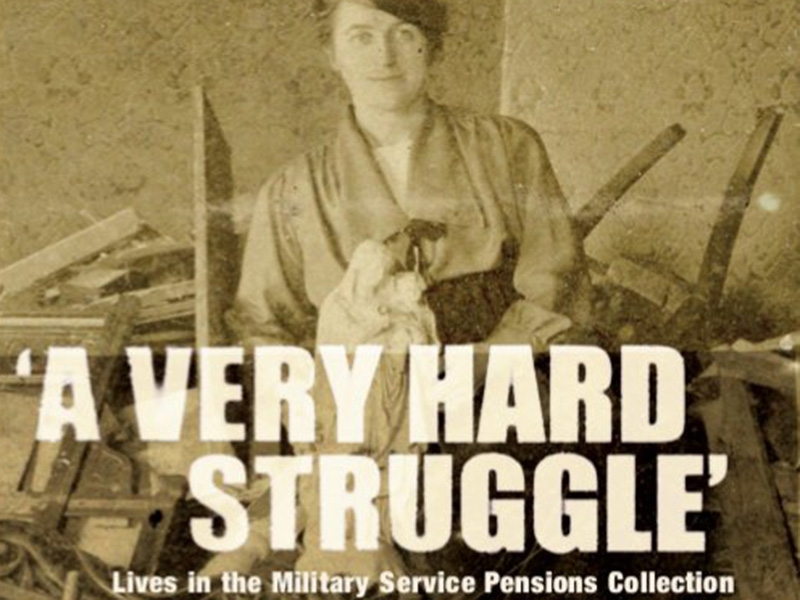
Anne Dolan and Caitriona Crowe. A Very Hard Struggle – Lives in the Military Service Pensions Collection (Dublin, Department of Defence, Ireland, 2023). Download, from https://www.militaryarchives.ie/collections/online-collections/military-service-pensions-collection-1916-1923/publications

Leeann Lane, Rosamond Jacob. Third Person Singular (Dublin: UCD Press, 2010).

Leeann Lane, Dorothy Macardle (Dublin: UCD Press, 2019).

Lindsey Earner-Byrne, Letters of the Catholic Poor: Poverty in Independent Ireland, 1920-1940 (Cambridge: Cambridge University Press, 2017)

Fionnuala Walsh, “‘A fanatical separation money mob’: The British Army Soldier’s Wife in Wartime Ireland, 1914-1918″ in British Journal of Military History, vol. 9, no. 2 (2023):106-124

Latest Podcasts

Military Communities’ Medical Welfare and Care History Conference Series

The Military Welfare History Network provides a networking and dissemination platform for scholars who are research active in military welfare history.

Thanks to the generous funding of the Wellcome Trust, through the Society for the Social History of Medicine, in 2025-26 the MWHN ran a three-part series of events.

Entitled the ‘The Military Communities’ Medical Welfare and Care History Conference Series’, this series comprised three accessible hybrid network events, which took place in the UK and online (via Zoom) over the course of the twenty-four months of the award. All of which focused on the burgeoning ‘perspective’ of military welfare history; defined as the welfare, care and medical provisions afforded to service personnel, their families and other dependents.

Attendees at the Military Welfare History Conference.

Keynotes from the Military Welfare History Network 2023 Conference

The first in-person meeting of the Military Welfare History Network took place in Sutherland School of Law, University College Dublin on 7 July 2023. The event, which was co-ordinated by Dr Paul Huddie, comprised two keynotes and four panels, totalling 14 speakers.

Conference keynotes by Dr Matthew Neufeld (University of Saskatchewan) and Dr Ke-Chin Hsia (Indiana University Bloomington) were recorded and are now available to podcast.

Military Welfare History Network 2024 Conference

The Military Welfare History Network provides a networking and dissemination platform for scholars who are research active in military welfare history.

In 2024 the Military Welfare History Network (MWHN) hosted its third international conference at the University of Leeds on 20 and 21 June. Led by Prof Jessica Meyer, the organising team hosted a two-day event at Leeds on the theme of ‘Economies of Military Welfare: conversations between past and present’. The conference was generously supported by the University of Leeds and the Economic History Society. Two papers recorded at the conference are now available to podcast.

Tudor and Stuart Ireland Conference Podcasts

Since 2011, researchers from a range of disciplines including History, Irish, English, Archaeology and Art History, have presented papers at Tudor and Stuart Ireland conferences. History Hub, in association with Real Smart Media, has produced more than 320 podcasts from these conferences.

Scroll to Top